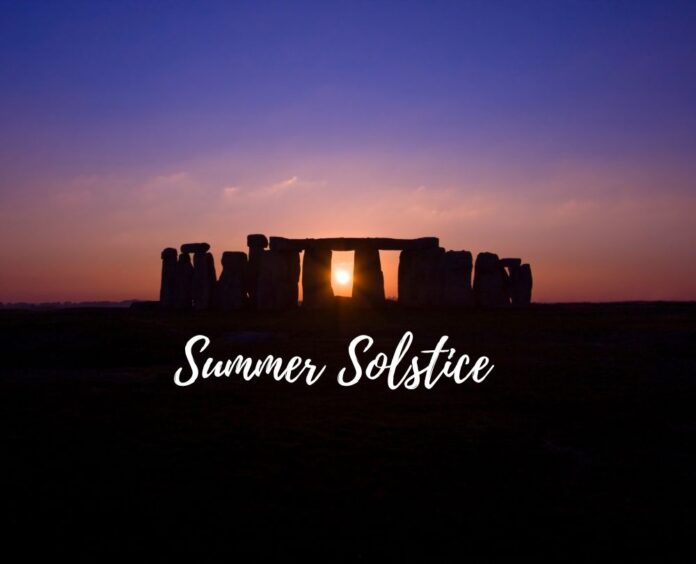
The Summer Solstice 2026 falls on Sunday, June 21, 2026, at 08:24 UTC (4:24 AM EDT / 9:24 AM BST). It marks the longest day of the year in the Northern Hemisphere and the astronomical start of summer. It is also the same day as Fathers Day 2026.
Table of Contents
What Is the Summer Solstice?
The summer solstice is the precise moment when the Sun reaches its northernmost position relative to Earth’s equator, producing the longest period of daylight in the Northern Hemisphere.
It is not a 24-hour event. It is a single instant — referred to in astronomy as the solstice moment.
The Scientific Definition
Earth’s axis is tilted at 23.5 degrees relative to its orbital plane. This tilt remains constant as Earth orbits the Sun.
At the June solstice, the Northern Hemisphere is tilted at its maximum angle toward the Sun.
The result: the Sun climbs to its highest arc in the sky, solar energy strikes the surface at the steepest possible angle, and daylight reaches its annual peak.
On this date, the Sun is directly overhead at solar noon along the Tropic of Cancer — the parallel at 23.5° North latitude.
Locations north of the Tropic never receive the Sun directly overhead at any point in the year; on the solstice, they receive it at their highest annual angle.
Locations south of the equator experience the opposite: the Sun is at its lowest arc, producing the shortest day of their year.
Why Seasons Are Not Caused by Earth’s Distance from the Sun
A persistent misconception holds that summer occurs because Earth is closer to the Sun. The opposite is true. Earth reaches perihelion — its closest point to the Sun — in early January, during Northern Hemisphere winter.
Seasons are caused entirely by axial tilt, which controls the angle and duration of solar radiation on any given surface, not by orbital distance.
What Does “Solstice” Mean?
The word solstice derives from Latin: sol (sun) and sistere (to stand still). At the solstice, the Sun’s apparent northward movement along the horizon pauses before reversing direction. This optical effect — the Sun seeming to “stand still” for a few days — gave the phenomenon its name.
The effect is most visible when tracking the Sun’s sunrise and sunset positions against a fixed landmark over several days around June 21.
Is the Summer Solstice the Same as the Summer Equinox?
No. A solstice and an equinox are opposite events. A solstice occurs when the Sun reaches its maximum northward or southward declination — when day length is at its extreme.
An equinox occurs when the Sun crosses the equatorial plane and day and night are approximately equal in length.
The term “summer equinox” is a common misnomer. No such event exists. The four seasonal markers are two solstices (June and December) and two equinoxes (March and September).
When Is the Summer Solstice 2026?
The Summer Solstice 2026 occurs on Sunday, June 21, 2026, at 08:24 UTC. The solstice moment is identical worldwide; only local clock times differ.
Summer Solstice 2026 Time by Time Zone
The table below lists the local time of the solstice moment across major cities and regions.
| City / Region | Local Time | Time Zone |
|---|---|---|
| Anchorage, Alaska, USA | 12:24 AM | AKDT |
| Los Angeles, USA | 1:24 AM | PDT |
| Denver, USA | 2:24 AM | MDT |
| Chicago / Houston, USA | 3:24 AM | CDT |
| New York, USA | 4:24 AM | EDT |
| London, UK | 9:24 AM | BST |
| Paris / Berlin | 10:24 AM | CEST |
| Dubai | 12:24 PM | GST |
| Mumbai | 1:54 PM | IST |
| Tokyo | 5:24 PM | JST |
| Sydney, Australia | 6:24 PM | AEST |
Note: Cities in the western United States experience the solstice moment in the very early hours of June 21, or — for Anchorage — just after midnight. The astronomical event itself remains the same instant regardless of local time.
Does the Summer Solstice Always Fall on June 21?
No. The summer solstice can fall on June 20, June 21, or, in rare cases, June 22. The date shifts because the Gregorian calendar year (365.25 days, accounting for leap years) does not align precisely with the tropical year (365.24219 days).
This slight mismatch causes the solstice to drift by several hours each year before leap-year corrections realign it. A June 22 solstice is extremely rare — the last occurred in 1975, and the next is not projected until 2203.
How Long Is Summer 2026?
Summer 2026 lasts 93 days, 15 hours, and 40 minutes. It begins at the solstice on Sunday, June 21, 2026, and ends at the autumn equinox on Tuesday, September 22, 2026, at 8:05 PM EDT. This is the astronomical definition of summer.
Meteorological summer, used by weather services, runs from June 1 through August 31 regardless of solstice and equinox dates.
The Longest Day of the Year 2026
Sunday, June 21, 2026, is the longest day of the year in the Northern Hemisphere. The number of daylight hours varies significantly by latitude — the farther north a location, the more daylight it receives on the solstice.
Daylight Hours on June 21, 2026 by Latitude
| Location | Approximate Latitude | Approximate Daylight Hours |
|---|---|---|
| Equator (Quito, Ecuador) | 0° | ~12 hours |
| Miami, USA / Cancún, Mexico | ~25°N | ~13.5 hours |
| New York, USA | ~41°N | ~15 hours |
| London, UK | ~51°N | ~16.5 hours |
| Paris, France | ~49°N | ~16 hours |
| Oslo, Norway | ~60°N | ~18.5 hours |
| Reykjavik, Iceland | ~64°N | ~21 hours |
| Fairbanks, Alaska, USA | ~65°N | ~22+ hours |
| Arctic Circle (66.5°N and above) | 66.5°N+ | 24 hours (Midnight Sun) |
| Utqiagvik (Barrow), Alaska | ~71°N | 84 consecutive days of sunlight |
At the equator, day length remains close to 12 hours throughout the year. The solstice effect intensifies with latitude. Above the Arctic Circle, the Sun does not set at all on June 21, 2026 — a phenomenon called the Midnight Sun.
When Is the Earliest Sunrise in 2026?
The earliest sunrise of the year does not occur on the summer solstice. At mid-latitudes in the Northern Hemisphere — including New York, London, and Paris — the earliest sunrise typically occurs approximately 5 to 10 days before the June 21 solstice, in the second week of June. The latest sunset occurs approximately 5 to 10 days after the solstice, in late June to early July.
This offset is caused by the equation of time, which accounts for the combined effects of Earth’s elliptical orbit (not a perfect circle) and its axial tilt. These factors cause the Sun to cross the meridian slightly earlier or later than clock-based noon throughout the year. The analemma — the figure-eight path the Sun traces in the sky at the same clock time each day — is a direct visualization of this effect.
In practical terms: the solstice produces the most total daylight, but the longest evening and the earliest morning do not coincide on the same date.
Why Is the Summer Solstice Not the Hottest Day of the Year?
The hottest days of the year in most Northern Hemisphere locations occur 4 to 6 weeks after the summer solstice — typically in late July or early August. This delay is caused by thermal lag (also called the lag of the seasons).
Although the solstice delivers the highest daily dose of solar radiation, Earth’s oceans, land masses, and lower atmosphere absorb and retain heat over time.
On June 21, these systems have not yet accumulated the maximum heat load from spring and early summer.
They continue absorbing solar energy for weeks after the solstice even as daily radiation begins to decline. Peak surface temperatures therefore lag significantly behind peak solar input.
The magnitude of thermal lag varies by location: coastal cities near large bodies of water experience a longer lag than inland continental locations, because water has a higher heat capacity than land and releases stored heat more slowly.
Summer Solstice 2026 and the Southern Hemisphere
June 21, 2026 is not the summer solstice in the Southern Hemisphere. It is the winter solstice. The June solstice is the astronomical beginning of winter in Australia, New Zealand, South Africa, Argentina, Chile, and all other Southern Hemisphere locations. It marks their shortest day and longest night.
Summer Solstice 2026 Date for the Southern Hemisphere
| Event | Date | UTC Time |
|---|---|---|
| Southern Hemisphere Winter Solstice | Sunday, June 21, 2026 | 08:24 UTC |
| Southern Hemisphere Summer Solstice | Monday, December 21, 2026 | 20:50 UTC |
For Southern Hemisphere audiences, the summer solstice — the longest day — falls on Monday, December 21, 2026. The Southern Hemisphere summer runs from the December solstice to the March equinox.
Inti Raymi and the June Solstice in South America
In Peru, the festival of Inti Raymi (“Festival of the Sun” in Quechua) is held each year on June 24, timed to coincide with the June solstice period. It honours Inti, the Incan sun deity, at the Sacsayhuamán fortress overlooking Cusco.
For the Andean cultures that observe it, June 21 marks not summer but the peak of winter — and the festival celebrates the return of the Sun and the promise of longer days ahead.
Inti Raymi is one of the largest annual festivals in South America, drawing tens of thousands of attendees.
Why Does the Summer Solstice Happen?
Summer Solstice 2026 — Astronomical Causes and Mechanics
The summer solstice occurs because Earth’s rotational axis is tilted at 23.44 degrees relative to the plane of its orbit around the Sun (the ecliptic plane).
This tilt does not change direction as Earth orbits — the axis points toward the same fixed point in space (near the star Polaris) throughout the year.
As Earth moves through its orbit, this fixed tilt causes each hemisphere to alternately lean toward or away from the Sun.
At the June solstice, the Northern Hemisphere is tilted at its maximum angle toward the Sun. At the December solstice, it is tilted at maximum angle away.
The Sun’s Position at the Tropic of Cancer
On the summer solstice, the Sun is directly overhead at solar noon for observers on the Tropic of Cancer — the circle of latitude at 23.44°N. This is the northernmost latitude at which the Sun can appear directly overhead at any point in the year.
North of this latitude, the Sun is never directly overhead; it always appears south of the zenith. South of the equator, the Sun is at its southernmost arc on this date, producing winter-like solar angles.
Solar Declination at the Solstice
Solar declination is the angle between the rays of the Sun and the plane of Earth’s equator. It ranges from −23.44° at the December solstice to +23.44° at the June solstice.
On June 21, 2026, solar declination reaches its maximum of +23.44°. This is the precise astronomical condition that defines the solstice moment.
Astronomical Summer vs. Meteorological Summer
These two definitions of “summer” begin on different dates and serve different purposes.
| Definition | Start Date (Northern Hemisphere) | End Date | Used By |
|---|---|---|---|
| Astronomical Summer | June 21, 2026 (solstice) | September 22, 2026 (equinox) | Astronomers, general reference |
| Meteorological Summer | June 1, 2026 | August 31, 2026 | Meteorologists, climate scientists |
Meteorological summer aligns with calendar months to simplify climate statistics and temperature averages.
It does not follow solstice or equinox timing. Astronomical summer is defined entirely by Earth’s orbital position relative to the Sun.
How the World Celebrates the Summer Solstice
Stonehenge, England
Stonehenge is the most internationally recognised solstice site. The monument’s Heel Stone aligns with the rising Sun on the summer solstice, directing the first light of dawn toward the centre of the stone circle.
Archaeologists date the monument’s construction to between 3000 and 1500 BCE, with the solstice alignment considered intentional by its Neolithic and Bronze Age builders.
English Heritage manages the site and opens it for a solstice access event. In recent years, attendance has exceeded 10,000 people for the solstice gathering. Access is free but must be registered in advance through English Heritage.
Places fill months ahead of the event. Alternative UK solstice sites include Avebury (Wiltshire), the Rollright Stones (Oxfordshire), and Glastonbury Tor (Somerset).
Midsommar — Scandinavia
Midsommar is one of the most culturally significant holidays in Sweden, Norway, Denmark, and Finland. In Sweden, it is legally observed as a public holiday on the Friday between June 19 and June 25.
Traditions include raising and dancing around a maypole (midsommarstång), weaving flower crowns, eating pickled herring, new potatoes, and strawberries, and staying outdoors through the near-continuous daylight.
In Denmark and Norway, coastal bonfires (sankthansblus) are lit on midsummer eve to mark the occasion. In Latvia, Estonia, and Lithuania, the Jāņi / Jaanipäev / Joninės festival centres on fire-jumping, which is considered to bring good fortune and purification.
Litha — The Pagan and Wiccan Midsummer Festival
Litha (pronounced LEE-thuh) is one of the eight Sabbats on the Wiccan Wheel of the Year. It falls on the summer solstice — June 21, 2026. In Pagan and Wiccan traditions, Litha marks the Sun at peak power, followed immediately by the slow return toward darkness.
Common observances include lighting bonfires or candles, gathering seasonal herbs (St. John’s Wort, lavender, mugwort), charging crystals in sunlight, and setting seasonal intentions.
Solar deities associated with this Sabbat include Lugh, Apollo, Helios, Brigid, and Freyja. In the Tarot, The Sun (Major Arcana XIX) is the card most commonly associated with Litha and the summer solstice period.
Ivan Kupala — Eastern Europe
Ivan Kupala Night is a Slavic fire and water festival observed in Russia, Ukraine, Belarus, and Poland on or around the June solstice, coinciding with the eve of the feast day of St. John the Baptist (June 23–24).
Traditional practices include jumping over bonfires (considered to bring health and luck), floating flower garlands on rivers to divine romantic futures, and gathering medicinal herbs, which folk tradition holds to be at peak potency on this night.
Mind Over Madness Yoga — Times Square, New York City
Every summer solstice, Times Square in New York City hosts free open-air yoga classes along the Broadway pedestrian plazas as part of the Mind Over Madness event, produced by Times Square Arts and the Times Square Alliance.
Classes run throughout the day from dawn to dusk, with multiple sessions for beginners and advanced practitioners. In-person registration is required. The 2026 event is scheduled for Sunday, June 21, 2026.
Midnight Sun Baseball Game — Fairbanks, Alaska
The Midnight Sun Game is an annual baseball game played in Fairbanks, Alaska, starting at approximately 10:30 PM on the night of the summer solstice, with no artificial lighting.
The game is possible because Fairbanks sits at 64.8°N latitude, where twilight persists throughout the night around the solstice.
The Alaska Goldpanners of Fairbanks have hosted the game since 1906, making it one of the longest-running solstice events in North America.
The Spiritual Meaning of the Summer Solstice 2026
Across multiple spiritual traditions, the summer solstice is interpreted as a threshold moment — the apex of light in the annual cycle before the gradual return toward darkness begins.
This is not metaphorical framing unique to one tradition; it is a consistent cross-cultural theme found in Celtic, Norse, Slavic, Incan, and modern Neopagan frameworks, all of which have independently structured ceremonies around this astronomical turning point.
Cancer Season and the Solstice — Astrology
In Western astrology, the Sun’s ingress into 0° Cancer marks the summer solstice. The Sun enters Cancer on Sunday, June 21, 2026, aligning the astronomical solstice exactly with the astrological seasonal change.
Cancer season themes — home, emotional foundation, intuition, nurturing, and cyclical rhythms — are considered to begin at this moment. The solstice chart (calculated for the exact UTC time of the ingress) is used by mundane astrologers as a seasonal forecast tool.
Summer Solstice 2026 Rituals
Ritual practices associated with the summer solstice span traditions but share common elements. The following observances are widely practised across Pagan, Wiccan, and secular spiritual communities:
- Sunrise watching: Observing the solstice sunrise from a meaningful outdoor location, aligning with historical practices at sites like Stonehenge and Chichén Itzá.
- Candle or fire ritual: Lighting a fire or candle at dawn or dusk to honour solar energy at its peak.
- Crystal charging: Placing crystals — particularly citrine, sunstone, and carnelian — in direct sunlight on the solstice day, a practice rooted in the belief that solar energy is at its annual maximum.
- Herb gathering: Harvesting St. John’s Wort, lavender, and mugwort, which folk traditions associate with heightened potency around Midsummer.
- Journaling and intention setting: Recording what is presently at its peak in one’s life, and identifying what may need to shift as days grow shorter.
- Outdoor yoga or movement: Practised in alignment with the solstice sunrise, popularised in part by events such as the Times Square Mind Over Madness gathering.
Summer Solstice 2026 for Kids
How to Explain the Summer Solstice to a Child
The summer solstice is the day with the most sunlight in the year. Earth is always slightly tilted to one side. When the tilted side faces the Sun, that side gets extra sunlight for more hours each day.
On June 21, 2026, the Northern Hemisphere is tilted toward the Sun as much as it will be all year. That makes the day longer and the night shorter than any other day.
Summer Solstice Activities for Children
The following activities are suited for children aged 5 to 12 and connect directly to solstice science and traditions:
- Build a sundial: Construct a basic gnomon sundial and track shadow direction and length throughout the solstice day. Shadows are shortest at solar noon — the moment when the Sun is at its highest point.
- Shadow measurement experiment: Measure the length of a shadow cast by a fixed object at 8 AM, 12 PM, and 4 PM. The noon shadow is measurably shorter on the solstice than on any other day of the year.
- Solstice nature crown: Weave a crown from flowers and leaves, a tradition practised in Scandinavian Midsommar celebrations.
- Sunrise observation: Record the exact time of sunrise and compare it to the same measurement taken a month earlier and a month later to observe the seasonal shift.
- World cultures project: Research how Stonehenge, Inti Raymi, and Midsommar each represent different cultural responses to the same astronomical event.
Classroom and Homeschool Connections
The summer solstice intersects multiple curriculum areas. In earth science, it demonstrates axial tilt, orbital mechanics, and the cause of seasons. In geography, daylight hours by latitude illustrate the relationship between location and solar energy.
In world history, Stonehenge, Incan astronomical knowledge, and Norse midsummer traditions connect the solstice to ancient civilisations. In mathematics, calculating the difference in daylight hours between cities at different latitudes introduces real-world application of geographic data.
Frequently Asked Questions: Summer Solstice 2026
When is the Summer Solstice 2026?
The Summer Solstice 2026 falls on Sunday, June 21, 2026, at 08:24 UTC. In New York, that is 4:24 AM EDT. In London, it is 9:24 AM BST.
Is June 21 always the date of the summer solstice?
No. The solstice can fall on June 20, June 21, or, very rarely, June 22. The date varies due to the mismatch between the Gregorian calendar year (365.25 days) and the tropical year (365.24219 days). Leap year corrections reduce but do not eliminate this drift.
Why is the summer solstice not the hottest day of the year?
Because of thermal lag. Earth’s land masses and oceans continue absorbing solar heat for 4 to 6 weeks after the solstice, even as daily radiation begins declining. Peak surface temperatures in most Northern Hemisphere locations occur in late July or August, not on June 21.
What is the difference between the summer solstice and an equinox?
A solstice occurs when the Sun reaches its maximum north or south declination. An equinox occurs when the Sun crosses the equatorial plane and day and night are approximately equal. The summer solstice is the longest day; the equinoxes produce near-equal day and night. These are distinct events separated by approximately three months.
When is the summer solstice 2026 in Australia?
June 21, 2026 is the winter solstice in Australia — the shortest day of the year. Australia’s summer solstice falls on Monday, December 21, 2026, at 20:50 UTC.
Does the earliest sunrise occur on the summer solstice?
Not precisely. At mid-latitudes in the Northern Hemisphere, the earliest sunrise typically occurs several days before the solstice, and the latest sunset occurs several days after. This offset is caused by the equation of time — the combined effect of Earth’s elliptical orbit and axial tilt on the timing of solar noon.
What is Litha?
Litha is the Pagan and Wiccan name for the summer solstice festival. It is one of eight Sabbats on the Wheel of the Year. Litha 2026 falls on Sunday, June 21, 2026.
What Comes After the Summer Solstice 2026?
From Monday, June 22, 2026 onward, daylight decreases in the Northern Hemisphere.
The rate of loss is slow immediately after the solstice — roughly 1 minute per day in the first weeks — then accelerates through late July and August.
The rate peaks around the autumn equinox in September, then slows again as the year moves toward the winter solstice.
Key Seasonal Dates: 2026–2027
| Seasonal Event | Date | Notes |
|---|---|---|
| Summer Solstice | Sunday, June 21, 2026 | Longest day, Northern Hemisphere |
| Autumn Equinox | Tuesday, September 22, 2026 | Day and night approximately equal |
| Winter Solstice | Monday, December 21, 2026 | Shortest day, Northern Hemisphere / Summer Solstice, Southern Hemisphere |
| Spring Equinox | Friday, March 20, 2027 | Day and night approximately equal |
Each of these four events divides the astronomical calendar into seasonal quarters. The summer solstice begins the longest of the four astronomical seasons — summer 2026, at 93 days, 15 hours, and 40 minutes, is longer than autumn, winter, or spring.
This asymmetry occurs because Earth moves slightly slower in its orbit when it is farther from the Sun (near aphelion, which falls on July 4, 2026), and faster when closer (near perihelion in early January).
Per Kepler’s second law of planetary motion, a planet sweeps equal areas in equal times — meaning Earth spends more time on the far side of its orbit, making Northern Hemisphere summer the longest of the four seasons by several days.

