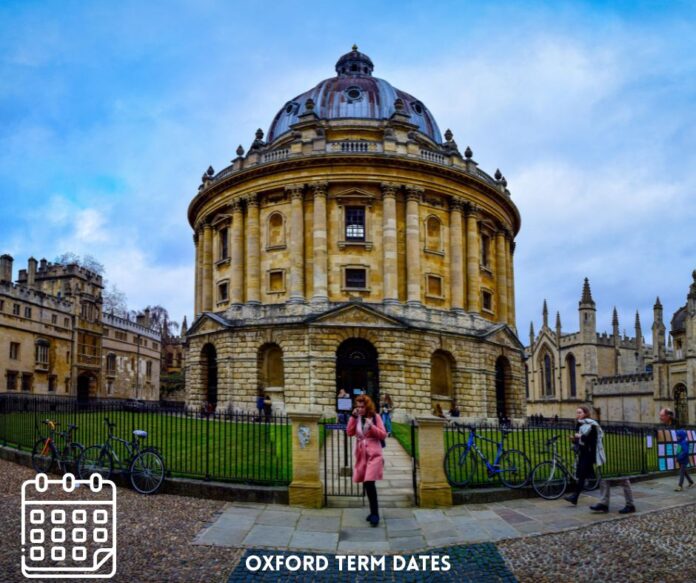
Oxford University operates on a three-term academic year — Michaelmas, Hilary, and Trinity — rather than the two-semester system used by most UK universities.
For the 2026–2027 academic year, Michaelmas Term begins on Sunday, 11 October 2026, Hilary Term begins on Sunday, 17 January 2027, and Trinity Term begins on Sunday, 25 April 2027. Each term runs for eight consecutive weeks, with no reading week at any point in the academic year.
This guide covers the confirmed University of Oxford term dates for 2026–2027, including week-by-week calendar breakdowns, Freshers’ Week dates, key ceremonies (Matriculation and Encaenia), local Oxford school calendars, and admissions information for prospective students.
Use the section links below to navigate directly to the information most relevant to you.
Table of Contents
Oxford University Term Dates 2026–2027 at a Glance
Oxford University’s three Full Terms for 2026–2027 are Michaelmas (11 October – 5 December 2026), Hilary (17 January – 13 March 2027), and Trinity (25 April – 19 June 2027).
Each lasts exactly eight weeks. These dates apply equally to all 39 Oxford colleges. Individual colleges set their own Noughth Week schedules, Collections exam windows, and formal events independently.
| Term | Start Date | End Date | Duration |
|---|---|---|---|
| Michaelmas 2026 | Sunday, 11 October 2026 | Saturday, 5 December 2026 | 8 weeks |
| Hilary 2027 | Sunday, 17 January 2027 | Saturday, 13 March 2027 | 8 weeks |
| Trinity 2027 | Sunday, 25 April 2027 | Saturday, 19 June 2027 | 8 weeks |
Each Full Term is preceded by a Noughth Week (Week 0), an informal preparatory week not listed on the official university calendar. During Michaelmas, Noughth Week is when Freshers’ Week takes place. During Hilary and Trinity, returning students use it for Collections and pre-term reading.
Michaelmas Term 2026 — Start Date, End Date, and Key Milestones
Michaelmas Term 2026 runs from Sunday, 11 October 2026 to Saturday, 5 December 2026. It is the first term of the Oxford academic year and the term during which all new undergraduate and postgraduate students are formally enrolled through Matriculation.
New students (Freshers) are expected in Oxford the week before Full Term begins. Noughth Week for Michaelmas 2026 runs from approximately Sunday, 4 October 2026 to Saturday, 10 October 2026. Students should plan to arrive by Friday, 2 October 2026 or Saturday, 3 October 2026 at the latest to complete college check-in formalities before welcome events begin. International students arriving from outside the UK should allow additional days for jet lag, UK arrival checks, and any necessary bank or mobile phone administration.
Full Term begins on Sunday, 11 October 2026. All eight weeks are teaching weeks. Oxford does not operate a reading week during any term in the academic year.
Hilary Term 2027 — Start Date, End Date, and Key Notes
Hilary Term 2027 runs from Sunday, 17 January 2027 to Saturday, 13 March 2027. Noughth Week falls approximately Sunday, 10 January 2027 to Saturday, 16 January 2027.
Hilary begins considerably later than the spring term at most other UK universities, which typically resume in early January. Students and families planning return travel after the Christmas vacation should note that Noughth Week does not begin until 10 January 2027. Hilary is widely regarded among Oxford students and tutors as the most academically intensive of the three terms, as there are no major ceremonies or university-wide events to interrupt the tutorial cycle.
Trinity Term 2027 — Start Date, End Date, and Examination Window
Trinity Term 2027 runs from Sunday, 25 April 2027 to Saturday, 19 June 2027. Noughth Week falls approximately Sunday, 18 April 2027 to Saturday, 24 April 2027.
Trinity is the final term of the Oxford academic year and contains the main undergraduate examination period — Final Honour School (FHS) examinations and Preliminary Examinations — which typically run from approximately Week 3 to Week 7 (Sunday, 9 May 2027 to Saturday, 12 June 2027). The Early May Bank Holiday falls on Monday, 3 May 2027, in Week 2.
The Spring Bank Holiday falls on Monday, 31 May 2027, in Week 6. Encaenia, Oxford’s annual graduation and honorary degree ceremony, takes place in the week following the end of Full Term, expected around Wednesday, 25 June 2027.
Oxford University Term Dates 2026–2027 PDF — Where to Download
The official Oxford term dates PDF is published by the University of Oxford on its website at ox.ac.uk. To locate it, navigate to the Academic Administration Division section and search “Academic Year Dates” in the site’s internal search.
The document confirms all Full Term start and end dates, key ceremony dates, and vacation windows. Students can also add term dates to a digital calendar using the iCal export option available on the same page, which is compatible with Google Calendar, Apple Calendar, and Microsoft Outlook.
Oxford Freshers’ Week 2026 — Dates, Events, and What to Expect
Oxford Freshers’ Week 2026 runs from approximately Sunday, 4 October 2026 to Saturday, 10 October 2026. This is Noughth Week of Michaelmas — the week immediately before Full Term begins on Sunday, 11 October 2026. This structure is unique to Oxford among UK universities.
At most institutions, Freshers’ Week coincides with the first week of term. At Oxford, it takes place the week before Full Term, which frequently causes confusion for new students expecting to start lectures during their first week in Oxford. Full Term lectures and tutorials do not begin until Week 1, which starts Sunday, 11 October 2026.
When Does Oxford Freshers’ Week 2026 Start?
Oxford Freshers’ Week 2026 begins on approximately Sunday, 4 October 2026. New students should plan to arrive by Friday, 2 October 2026 or Saturday, 3 October 2026. College accommodation check-in typically opens over that arrival weekend, and some introductory sessions begin as early as the Saturday evening.
Arriving later than Sunday, 4 October 2026 risks missing college welcome events and early administrative tasks including University card collection, which is required for accessing libraries, buildings, and university services.
What Happens During Oxford Freshers’ Week 2026?
During Noughth Week (Freshers’ Week), new students engage in a structured programme of college-led and university-wide events. Events vary by college and are published on individual college websites ahead of term. The following activities are standard across Oxford colleges during Freshers’ Week:
- College welcome sessions led by the Principal, Master, or Warden of the college
- Academic induction meetings with assigned tutors
- University card (Bod card) collection from the Card Office
- Bodleian Library registration and orientation
- Sub fusc academic dress hire appointment at Shepherd & Woodward, High Street, Oxford
- Oxford University Student Union (OUSU) Freshers’ Fair — a two-day event where students register for sports clubs, academic societies, and other groups
- Oxford Union introductory sessions
- Gown fitting and hire for Matriculation, which takes place in Week 1 of Full Term
Matriculation itself — the formal enrolment ceremony conducted in Latin — does not take place during Freshers’ Week. It takes place in Week 1 of Full Term, approximately 11–17 October 2026. Attendance is compulsory.
Oxford Freshers’ Week 2026 — Key Arrival Checklist
New students should complete the following tasks on or before the start of Full Term on Sunday, 11 October 2026:
- Collect the University card (Bod card) from the University Card Office, typically open during Noughth Week
- Complete accommodation check-in with the college porter’s lodge
- Attend all compulsory college induction sessions (published in advance by each college)
- Hire or purchase sub fusc academic dress for Matriculation from Shepherd & Woodward or a similar Oxford supplier
- Register with a local Oxford GP surgery — GP registration waiting times can extend several weeks into term
- Open a UK bank account, if not done prior to arrival — several UK banks accept student applications before arrival using the university’s CAS (Confirmation of Acceptance for Studies) letter
- Collect pre-ordered reading list books from Blackwell’s Bookshop on Broad Street or the relevant college library
- Confirm the tutorial timetable with your assigned tutor for Week 1
How Does the Oxford Term System Work?
Oxford University’s academic year is structured around three eight-week terms rather than the two-semester model used by most UK, US, and European universities. The total teaching commitment across all three terms amounts to approximately 24 weeks per academic year — significantly shorter than comparable institutions — but tutorials, essays, and independent reading requirements make each week more intensive per contact hour than a standard semester timetable.
How Many Terms Are in an Oxford Year?
Oxford University has three terms per academic year: Michaelmas (autumn), Hilary (spring), and Trinity (summer). Each Full Term lasts eight weeks. There is no reading week in any Oxford term. This three-term structure distinguishes Oxford from the majority of UK universities, which operate two semesters of approximately 12–15 teaching weeks each. Oxford shares the three-term structure with the University of Cambridge, though Cambridge uses slightly different term names: Michaelmas (shared), Lent (equivalent to Oxford’s Hilary), and Easter (equivalent to Oxford’s Trinity).
What Is “Full Term” at Oxford? The Full Term vs Total Residence Distinction
“Full Term” at Oxford refers to the official eight-week teaching period during which lectures, tutorials, and formal academic commitments are scheduled. It is not the same as “Total Residence,” which is the extended period students are required to be in Oxford and in college accommodation — encompassing Noughth Week before Full Term and, in some colleges, additional days at the end.
This distinction carries practical consequences. Accommodation contracts, visa compliance obligations, and college regulations are typically tied to Total Residence rather than Full Term. Students who vacate Oxford before the end of their Total Residence period may breach college or university regulations. International students on a Student Visa should confirm their Total Residence dates with their college directly, as these can extend beyond the Full Term end dates published centrally.
What Is Noughth Week (Week 0) at Oxford?
Noughth Week — also written as Week 0 — is the informal week immediately before Full Term begins. The term derives from an archaic English usage meaning zero. During Michaelmas, Noughth Week is Freshers’ Week for new students. During Hilary and Trinity, returning students use it for Collections (college-level internal assessments), pre-term reading, and academic preparation. Noughth Week does not appear in the official University of Oxford term dates publication but is universally recognised by students, staff, and the university’s administrative systems.
What Do Michaelmas, Hilary, and Trinity Mean?
The three Oxford term names derive from the Christian liturgical calendar, reflecting the university’s medieval origins.
Michaelmas takes its name from the Feast of St Michael the Archangel, observed on 29 September, which historically marked the start of the autumn legal and academic year.
Hilary refers to St Hilary of Poitiers, a fourth-century theologian whose feast day falls on 13 January.
Trinity refers to Trinity Sunday — the Christian feast celebrating the Holy Trinity — which falls in late May or early June. These term names are used exclusively by Oxford and Cambridge among UK universities and are typically unfamiliar to international applicants on first encounter.
Oxford 2026–2027 Academic Calendar: Full Week-by-Week Breakdown
No publicly available resource currently provides a week-by-week calendar for Oxford’s 2026–2027 academic year with exact Sunday-to-Saturday date ranges. The tables below fill that gap using the confirmed official Full Term start dates.
Michaelmas Term 2026 — Week-by-Week Calendar
| Week | Dates | Key Events |
|---|---|---|
| Noughth Week | Sunday, 4 October – Saturday, 10 October 2026 | Freshers’ Week; college check-in; Bod card collection; sub fusc hire; OUSU Freshers’ Fair |
| Week 1 | Sunday, 11 October – Saturday, 17 October 2026 | Full Term begins; Matriculation ceremony (compulsory); first tutorials |
| Week 2 | Sunday, 18 October – Saturday, 24 October 2026 | Lectures and tutorials in full session |
| Week 3 | Sunday, 25 October – Saturday, 31 October 2026 | — |
| Week 4 | Sunday, 1 November – Saturday, 7 November 2026 | — |
| Week 5 | Sunday, 8 November – Saturday, 14 November 2026 | — |
| Week 6 | Sunday, 15 November – Saturday, 21 November 2026 | — |
| Week 7 | Sunday, 22 November – Saturday, 28 November 2026 | — |
| Week 8 | Sunday, 29 November – Saturday, 5 December 2026 | Final week of Full Term |
| Christmas Vacation | From Sunday, 6 December 2026 | Vacation begins; no compulsory residence |
Oxford does not operate a reading week during Michaelmas. All eight weeks are full teaching weeks. The Christmas Vacation begins on Sunday, 6 December 2026 and continues until Noughth Week of Hilary Term in January 2027.
Hilary Term 2027 — Week-by-Week Calendar
| Week | Dates | Key Events |
|---|---|---|
| Noughth Week | Sunday, 10 January – Saturday, 16 January 2027 | Returning students arrive; Collections (college internal assessments) |
| Week 1 | Sunday, 17 January – Saturday, 23 January 2027 | Full Term begins |
| Week 2 | Sunday, 24 January – Saturday, 30 January 2027 | — |
| Week 3 | Sunday, 31 January – Saturday, 6 February 2027 | — |
| Week 4 | Sunday, 7 February – Saturday, 13 February 2027 | — |
| Week 5 | Sunday, 14 February – Saturday, 20 February 2027 | — |
| Week 6 | Sunday, 21 February – Saturday, 27 February 2027 | — |
| Week 7 | Sunday, 28 February – Saturday, 6 March 2027 | — |
| Week 8 | Sunday, 7 March – Saturday, 13 March 2027 | Final week of Full Term |
| Easter Vacation | From Sunday, 14 March 2027 | Vacation begins |
Students returning from the Christmas vacation should note that they are not required in Oxford until Noughth Week begins on Sunday, 10 January 2027. This contrasts with most UK universities whose spring terms resume in the first week of January.
Trinity Term 2027 — Week-by-Week Calendar
| Week | Dates | Key Events |
|---|---|---|
| Noughth Week | Sunday, 18 April – Saturday, 24 April 2027 | Returning students; pre-examination preparation |
| Week 1 | Sunday, 25 April – Saturday, 1 May 2027 | Full Term begins |
| Week 2 | Sunday, 2 May – Saturday, 8 May 2027 | Early May Bank Holiday: Monday, 3 May 2027 |
| Week 3 | Sunday, 9 May – Saturday, 15 May 2027 | FHS and Preliminary Examinations typically begin |
| Week 4 | Sunday, 16 May – Saturday, 22 May 2027 | Main undergraduate examination period |
| Week 5 | Sunday, 23 May – Saturday, 29 May 2027 | Main undergraduate examination period |
| Week 6 | Sunday, 30 May – Saturday, 5 June 2027 | Spring Bank Holiday: Monday, 31 May 2027 |
| Week 7 | Sunday, 6 June – Saturday, 12 June 2027 | Final examinations |
| Week 8 | Sunday, 13 June – Saturday, 19 June 2027 | Final week of Full Term |
| Long Vacation | From Sunday, 20 June 2027 | Long Vacation begins |
When Are Oxford University Exams in 2027?
Oxford’s main undergraduate examinations are held during Trinity Term 2027, typically between Weeks 3 and 7 — approximately Sunday, 9 May 2027 to Saturday, 12 June 2027. These include Final Honour School (FHS) examinations for finalist undergraduates and Preliminary Examinations (Prelims) for first-year students.
Subject-specific examination timetables are published by Oxford’s Examination Schools and appear in the University of Oxford Gazette. All undergraduate examinations take place at the Examination Schools on High Street, Oxford. Students must wear sub fusc academic dress to all examinations.
What Is the Oxford Long Vacation 2027?
The Long Vacation begins on Sunday, 20 June 2027 and continues through to Noughth Week of Michaelmas Term in October 2027. It is Oxford’s longest vacation period — spanning approximately 15 weeks — and runs across the summer months.
Unlike the Christmas and Easter vacations, many DPhil (doctoral research) students remain in Oxford throughout the Long Vacation to continue research. Undergraduate students are not required to reside in Oxford during the Long Vacation but frequently return for internships, dissertation research, or academic conferences.
Key Oxford University Events and Ceremonies 2026–2027
The Oxford academic calendar is structured around several formal ceremonies and institutional events that are linked directly to term dates. These events are not optional for current students — several carry compulsory attendance requirements — and form a significant part of Oxford’s institutional identity.
Oxford Matriculation 2026 — Date, Dress Code, and What to Expect
Matriculation 2026 takes place in Week 1 of Michaelmas Term, approximately between Sunday, 11 October and Saturday, 17 October 2026. It is the formal enrolment ceremony through which new students become members of the University of Oxford. The ceremony is conducted in Latin by the Vice-Chancellor or a senior officer of the university, typically in the Sheldonian Theatre.
All students attending Matriculation must wear sub fusc — Oxford’s formal academic dress. Sub fusc for undergraduates consists of a dark suit or dark skirt, a white shirt or blouse, a white bow tie (or white ribbon for those in a skirt), a black academic gown appropriate to the student’s course, and a mortarboard.
Sub fusc can be hired or purchased from Shepherd & Woodward at 109 High Street, Oxford. Attendance at Matriculation is compulsory. Students who miss Matriculation without prior authorisation from their college must typically complete an alternative enrolment process, which varies by college.
Matriculation is distinct from a graduation or degree ceremony. It marks the formal start of a student’s membership of the university rather than its conclusion.
Encaenia 2027 — Oxford University’s Annual Graduation Ceremony
Encaenia 2027 is expected to take place on approximately Wednesday, 25 June 2027, in the week following the end of Trinity Full Term. Encaenia is Oxford’s annual ceremony for conferring honorary degrees on distinguished individuals. The word derives from the Greek ἐγκαίνια, meaning renewal or dedication. Oxford does not use the term “graduation” for this event.
Student degree ceremonies — at which individual students receive their degrees — take place separately in Congregation meetings held throughout the year in the Sheldonian Theatre.
These are distinct from Encaenia. Families attending the Encaenia procession through central Oxford, which passes along the High Street and Broad Street, observe one of the university’s most publicly visible annual events. Honorary degree recipients at Encaenia have historically included Nobel laureates, heads of state, and major cultural figures.
Oxford Collections — What They Are and When They Happen
Collections are college-level internal assessments held at the start of each term, typically during Noughth Week, that review work from the previous term. They are set and marked by individual college tutors rather than the University centrally and do not contribute formally to a student’s final degree classification.
However, they inform academic progress reports and influence tutor assessments of a student’s readiness for examinations. Collections are held across all three terms but are most significant at the start of Hilary and Trinity, when they test Michaelmas and Hilary work respectively. Noughth Week of Hilary (Sunday, 10 January – Saturday, 16 January 2027) is the standard window for Hilary Collections.
Oxford University School Term Dates 2026–2027 — Local Schools and Colleges
The term dates listed in this section are for schools and further education institutions in Oxford and Oxfordshire. These are entirely separate from the University of Oxford calendar. Parents and families in Oxford frequently cross-reference university and school dates, particularly during Christmas and Easter vacations, when vacation windows do not always align. The institutional calendars below follow Oxfordshire County Council (OCC) and individual school governing body schedules.
Oxfordshire County Council School Term Dates 2026–2027
The majority of state schools in Oxford and Oxfordshire follow the academic calendar published by Oxfordshire County Council (OCC). The 2026–2027 OCC school year is structured across three terms: Autumn (September–December 2026), Spring (January–April 2027), and Summer (April–July 2027).
State school INSET (In-Service Training) days vary by individual school — typically five days per academic year — and are set by each school’s headteacher or governing body independently of the OCC calendar.
Confirmed 2026–2027 OCC term dates are published at oxfordshire.gov.uk. Parents should check their specific school’s term dates directly, as individual schools may vary from the OCC pattern by up to one week on INSET days.
Cherwell School Oxford Term Dates 2026–2027
The Cherwell School is a state secondary school located in north Oxford, operating under the Cherwell Valley Schools Trust. Its term dates follow the Oxfordshire County Council schedule.
The 2026–2027 term dates for Cherwell School are published on the school’s website and via the OCC portal. INSET days specific to Cherwell School are listed separately and do not always coincide with dates on the OCC master calendar.
Swan School Oxford Term Dates 2026–2027
The Swan School of English is an independent English language school in Oxford, serving international students of all ages on short and long-term course programmes. Unlike state schools or the University of Oxford, the Swan School operates on a rolling intake model with courses starting throughout the year rather than on fixed academic terms.
The Swan School’s 2026–2027 course schedule is published at swanschool.co.uk. Students should confirm their specific course start and end dates directly with the school, as these vary by course type and duration.
St Clare’s Oxford Term Dates 2026–2027
St Clare’s Oxford is an independent, co-educational college in north Oxford offering International Baccalaureate (IB) Diploma and A-Level programmes. Its term structure follows the English independent school calendar — three terms per year — with examination windows aligned to the IB May session and A-Level summer examination series.
IB Diploma students at St Clare’s sit their main examinations in May 2027, during a window that partially overlaps with Oxford University’s Trinity Term. Confirmed 2026–2027 term dates are published at stclares.ac.uk.
Activate Learning Oxford Term Dates 2026–2027
Activate Learning is a further education (FE) group operating several campuses in Oxford, including the Oxford City campus. Its academic year follows the standard FE sector calendar, which differs from both the University of Oxford and the state school schedule. Activate Learning’s 2026–2027 term dates are published at activatelearning.ac.uk. FE calendars typically begin in early September and include more contact hours per week than university-style programmes, with fewer vacation weeks than the university pattern.
Magdalen College School (MCS) Oxford Term Dates 2026–2027
Magdalen College School (MCS) is an independent day school adjacent to Magdalen College, Oxford, offering education from Year 7 through the Sixth Form. As an independent school, MCS sets its term dates independently of Oxfordshire County Council. Its calendar broadly follows the English independent school pattern — Michaelmas, Lent, and Summer terms — though MCS uses these names in their school rather than university sense. Confirmed 2026–2027 MCS term dates are published at mcsoxford.org.
City of Oxford College Term Dates 2026–2027
City of Oxford College is a further education provider in central Oxford offering vocational, professional, and academic programmes. Its 2026–2027 term dates follow the FE sector calendar. Confirmed dates are published at cityofoxford.ac.uk. City of Oxford College is not affiliated with the University of Oxford.
Oxford Term Dates Compared — University vs Other UK Universities
When Does Oxford University Start Compared to Other UK Universities?
Oxford University starts Michaelmas Term on Sunday, 11 October 2026 — three to four weeks later than most UK universities, which typically begin their autumn term in mid-to-late September. The later start is a structural feature of Oxford’s concentrated eight-week term model. Because Oxford’s terms are shorter and more intensive per week than semester-based equivalents, an October start compensates for the reduced vacation time between summer and Michaelmas.
For students transitioning directly from UK sixth forms — which typically resume in September — or from gap year commitments, the period between early September and early October 2026 can be used for preparation, pre-reading, and Oxford-specific administrative tasks (such as accommodation confirmation and academic dress sourcing).
Oxford vs Cambridge Term Dates 2026–2027 — How Do They Compare?
Oxford and Cambridge share an eight-week Full Term structure but use different names for their second and third terms, and dates typically differ by a few days to one week. The comparison table below maps the two term structures.
| Feature | University of Oxford | University of Cambridge |
|---|---|---|
| Term structure | 3 terms per year | 3 terms per year |
| Full Term length | 8 weeks | 8 weeks |
| Autumn term name | Michaelmas | Michaelmas |
| Spring term name | Hilary | Lent |
| Summer term name | Trinity | Easter |
| Michaelmas 2026 start | Sunday, 11 October 2026 | Varies — verify at cam.ac.uk |
| Reading week | None | None |
| Graduation ceremony name | Encaenia | General Admission |
Families with children attending both universities simultaneously should verify each institution’s calendar individually, as vacation windows — while structurally similar — do not always align by exact date. The Cambridge 2026–2027 academic calendar is confirmed at cam.ac.uk.
Does Oxford University Use Semesters or Terms?
Oxford University uses terms, not semesters. This is a common point of confusion for international applicants from the United States, continental Europe, Australia, and other systems where semesters of 12–15 weeks are standard. Oxford’s three eight-week terms are more concentrated per teaching week than a typical semester, with tutorial obligations — typically one written essay and one tutorial meeting per week — running continuously across all eight weeks of each term without a mid-term break.
Oxford University Admissions and Student Life — Key Questions for 2026
What Month Does Oxford University Start?
Oxford University starts in October. Michaelmas Term 2026 begins on Sunday, 11 October 2026. New undergraduate and postgraduate students arrive for Freshers’ Week during Noughth Week, approximately Sunday, 4 October 2026 to Saturday, 10 October 2026. The academic year then follows a pattern of October (Michaelmas), January (Hilary), and April (Trinity) as the three term start months.
What GPA Do You Need to Get Into Oxford University?
For US applicants, the University of Oxford typically expects a GPA of 3.7 or above on a 4.0 scale, though the exact threshold varies by course and college. Oxford evaluates US applicants on a combination of GPA, SAT/ACT scores, and Advanced Placement (AP) or International Baccalaureate (IB) results rather than GPA alone. For UK applicants, entry requirements are expressed as A-Level grades — typically A*AA or AAA for most courses. Medicine (A-Level requirements of A*AA plus the UCAT and BMAT), Law, and PPE (Philosophy, Politics and Economics) require near-perfect predicted grades combined with strong written work, admissions test performance, and college interview scores. International students should verify course-specific entry requirements at ox.ac.uk/admissions.
What Is the Hardest Oxford College to Get Into?
Balliol College and Merton College are frequently cited as the most academically selective Oxford colleges. However, acceptance rates vary substantially by subject across all colleges. The competitive intensity of a specific college-subject combination is a more reliable metric than overall college selectivity. Students applying to Medicine, Law, or PPE face the highest application-to-place ratios regardless of which college they select. Applicants who are not admitted to their first-choice college may be pooled and offered a place at an alternative college — a process that does not affect the degree awarded or the academic environment.
What Is the Easiest Degree to Get Into at Oxford?
History and Classics typically record slightly higher acceptance rates than STEM and professional subjects at Oxford, though all courses remain among the most competitive in the UK. All applicants to Oxford — regardless of subject — are required to sit a written admissions test, submit marked academic work in most subjects, and attend college interviews. The offer rate across all Oxford courses for UK applicants was approximately 18% in the 2023–2024 admissions cycle, according to University of Oxford data. Students are advised to apply to the subject they are most prepared for academically, as interview performance and written exercise quality are the primary differentiators in the admissions process.
Can You Get a 100% Scholarship to Oxford University?
Yes — several fully funded awards cover both tuition fees and living costs for Oxford study. The Clarendon Fund is Oxford’s largest graduate scholarship programme, awarding approximately 140 fully funded awards per year across all subject areas. Recipients are identified automatically during the graduate admissions process — no separate application is required. The Weidenfeld-Hoffmann Scholarships support students from developing countries in leadership-oriented graduate programmes. The Rhodes Scholarship is one of the most prestigious fully funded international awards, enabling students from over 60 countries to study any Oxford graduate programme. The majority of full scholarships at Oxford are available to graduate (postgraduate) students rather than undergraduates. Full undergraduate scholarships are rare; undergraduate students from lower-income households in the UK are typically supported via Oxford’s access bursaries and the government maintenance loan system.
Oxford University — Alumni, Facts, and Rankings
Which Billionaires and Celebrities Studied at Oxford University?
Oxford’s alumni include more than 30 world leaders, over 50 Nobel Prize winners, and numerous internationally recognised figures across business, arts, and public life. Notable alumni include Tony Blair (Prime Minister of the United Kingdom, read Law), Bill Clinton (Rhodes Scholar, read Politics at University College), Malala Yousafzai (Nobel Peace Prize laureate, read Philosophy, Politics and Economics at Lady Margaret Hall), Rupert Murdoch (media executive, read Politics, Philosophy and Economics at Worcester College), Aung San Suu Kyi (Nobel Peace Prize laureate), Hugh Grant (actor, read English at New College), Rosamund Pike (actress, read English at Wadham College), and Imran Khan (former Prime Minister of Pakistan, read Philosophy, Politics and Economics at Keble College).
Emma Watson — a frequently searched name in relation to Oxford — studied English Literature at Worcester College, Oxford, alongside her acting career.
Is Oxford University Older Than Harvard?
Yes. Oxford University predates Harvard University by approximately 450 to 500 years. Teaching at Oxford is recorded as early as 1096, with a rapid expansion in student numbers and academic organisation documented between 1167 and 1185 following the expulsion of English scholars from the University of Paris. The University of Oxford is the oldest university in the English-speaking world. Harvard University was founded in 1636 in Cambridge, Massachusetts. Oxford also predates the Aztec Empire (founded approximately 1428), the Gutenberg printing press (c. 1440), and Christopher Columbus’s first voyage to the Americas (1492).
What Is the Average Salary of an Oxford Graduate?
Oxford graduates consistently rank among the highest earners in the UK at five and fifteen years post-graduation. Graduate outcomes data published by the University of Oxford indicates that alumni in Law, Medicine, Finance, and Computer Science from Oxford command the highest salaries among subject cohorts. Oxford’s position in international university league tables — ranked 1st globally by the Times Higher Education World University Rankings in multiple consecutive years — directly correlates with employer recruitment priority. Salary outcomes vary substantially by subject, college, graduation year, and career sector and should be reviewed using Oxford’s graduate outcomes data at ox.ac.uk.
Frequently Asked Questions — Oxford Term Dates 2026–2027
What Are the Term Dates for Oxford University 2026–2027?
Oxford University term dates for 2026–2027 are: Michaelmas Term — Sunday, 11 October to Saturday, 5 December 2026; Hilary Term — Sunday, 17 January to Saturday, 13 March 2027; Trinity Term — Sunday, 25 April to Saturday, 19 June 2027. Each term lasts eight weeks.
How Many Terms Are in an Oxford Year?
Oxford University has three terms per academic year: Michaelmas (autumn), Hilary (spring), and Trinity (summer). Each Full Term lasts eight weeks, giving a total of 24 taught weeks per academic year. Oxford does not divide the year into semesters.
What Are the School Terms at Oxford?
The three Oxford University terms are Michaelmas, Hilary, and Trinity. Michaelmas runs October to December, Hilary runs January to March, and Trinity runs April to June. These replace the conventional Autumn, Spring, and Summer term labels used by most UK state schools and universities.
Do Oxford Term Dates Differ by College?
No. Full Term dates are set centrally by the University of Oxford and apply identically across all 39 Oxford colleges. Individual colleges determine their own Noughth Week programmes, Collections schedules, and formal events. Students should consult their specific college’s term calendar alongside the university-wide dates.
Where Can I Get the Oxford Term Dates 2026–2027 PDF?
The official Oxford term dates PDF is published on the University of Oxford website at ox.ac.uk. Navigate to the Academic Administration Division or use the site search for “Academic Year Dates.” The PDF confirms all Full Term start and end dates, vacation windows, and key university-wide ceremony dates for the 2026–2027 academic year.
Are Oxford Term Dates the Same as Oxford Brookes Term Dates?
No. Oxford Brookes University operates on a separate academic calendar from the University of Oxford. Oxford Brookes runs two semesters per year rather than three terms. Oxford Brookes term dates for 2026–2027 are published at brookes.ac.uk. Students at Oxford Brookes should not use University of Oxford dates to plan their academic year.

