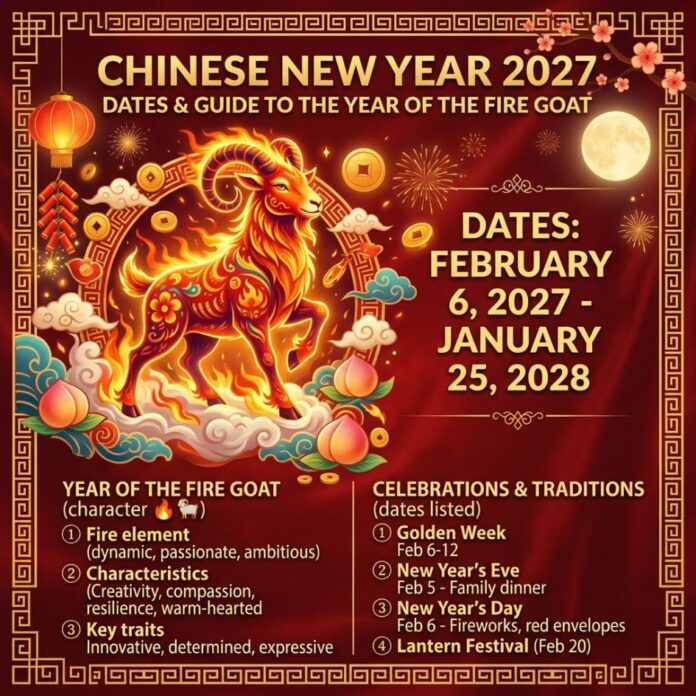
Chinese New Year 2027 falls on Saturday, February 6, 2027, marking the first day of the Year of the Fire Goat (丁未, Dīng Wèi) in the Chinese lunisolar calendar.
In the Chinese zodiac, 2027 is the Year of the Fire Goat, and the Chinese Lunar New Year begins on February 6, 2027, starting the 15-day Spring Festival that concludes with the Lantern Festival.
The date is not fixed on the Gregorian calendar because it is set by lunar-solar rules rather than a solar-only calendar.
The exact timing depends on the second new moon after the winter solstice, which places Lunar New Year between January 21 and February 20 in the Gregorian calendar.
This is not a generic overview of Chinese New Year as a concept. It is a year-specific reference for 2027: the confirmed calendar dates, the Fire Goat zodiac designation, region-by-region public holiday schedules, the global shipping impact, and the cultural practices tied to this particular year.
Table of Contents
When Is Chinese New Year 2027? Key Dates at a Glance
Chinese New Year 2027 begins on Saturday, February 6, 2027, and the core festival period runs for 15 days, ending with the Lantern Festival on Saturday, February 20, 2027. The 15-day Spring Festival concludes with the Lantern Festival.
The table below lists the fixed milestones of the 2027 festival cycle.
| Milestone | Gregorian Date | Day of Week | Significance |
|---|---|---|---|
| Chinese New Year’s Eve | February 5, 2027 | Friday | Reunion dinner, family gathering |
| Chinese New Year 2027 (Day 1) | February 6, 2027 | Saturday | First day of the Fire Goat year |
| Second Day | February 7, 2027 | Sunday | Married daughters visit their parents |
| Third Day | February 8, 2027 | Monday | Traditionally avoided for social visits |
| Renri (Human Day) | February 12, 2027 | Friday | Traditionally regarded as everyone’s birthday |
| Lantern Festival (Day 15) | February 20, 2027 | Saturday | Closing day of the festival |
Chinese New Year’s Eve 2027
Chinese New Year’s Eve 2027 falls on Friday, February 5, 2027, the night of the reunion dinner. Chinese New Year’s Eve is the day before Chinese New Year, and the holiday falls between January 21 and February 20 on the Gregorian calendar.
Families gather for the year’s largest meal, and in many households this is the only night of the year when every generation eats together at one table.
First Day of Chinese New Year 2027: February 6
The first day of Chinese New Year 2027 is Saturday, February 6, 2027, the point at which the Year of the Fire Goat officially begins. The Chinese Lunar New Year begins February 6, 2027, and starts the 15-day Spring Festival.
Because the date falls on a weekend in 2027, several countries that normally grant a weekday holiday will add a substitute day off, a detail covered in the country-by-country section below.
Lantern Festival 2027
The Lantern Festival, which closes the Chinese New Year 2027 season, falls on Saturday, February 20, 2027, the 15th day of the first lunar month.
It marks the first full moon of the lunar year and traditionally involves lantern displays, riddle-guessing games, and the eating of tangyuan (glutinous rice balls).
Unlike New Year’s Day itself, the Lantern Festival is not a statutory public holiday in mainland China, though it remains widely observed culturally.
How Long the Celebration Lasts
The Chinese New Year 2027 celebration lasts 15 days, running from February 6 through February 20, 2027.
This does not mean 15 days of continuous public holiday; the statutory time off is shorter in every country that observes it (see the holiday table below), while the cultural celebration period — visiting relatives, exchanging greetings, keeping specific customs on specific days — extends across the full 15 days.
What Zodiac Animal Is 2027? The Year of the Fire Goat Explained
2027 is the Year of the Goat in the Chinese zodiac, specifically the Fire Goat, based on the 12-animal cycle combined with the five-element system. Chinese New Year 2027 is a Year of the Goat, more specifically, the Fire Goat.
The animal governs the year’s general symbolism; the element (Fire, in 2027’s case) modifies that symbolism and does not repeat again for another 60 years.
Goat, Sheep, or Ram? Resolving the Translation Question
2027 is correctly called the Year of the Goat, though “Sheep” and “Ram” are also accurate translations of the same Chinese character.
The ambiguity exists because the character 羊 (yáng) is a generic term for the caprine family and does not distinguish between a domesticated sheep (绵羊), a goat (山羊), or a ram (a male sheep), the way English does.
This is why English-language sources split roughly between “Goat” and “Sheep” for the same year. The year 2027 corresponds to the Year of the Sheep, or Goat, specifically the Fire Sheep.
Neither translation is wrong; “Goat” has become the more common English default in recent zodiac cycles, but “Sheep” remains equally valid and appears throughout Western media coverage of the same year.
Why 2027 Is a Fire Goat, Not Just a Goat Year
2027 is a Fire Goat year because Chinese astrology pairs each of the 12 zodiac animals with one of five elements — Wood, Fire, Earth, Metal, and Water — on a rotating basis, and 2027 lands on the Fire phase of that rotation.
In the Chinese zodiac, 2027 is the Year of the Fire Goat (or Ram).
Each element governs two consecutive years (a yang year and a yin year) before advancing, so the full animal-element combination does not repeat for 60 years.
2026 is a Yang Fire year (Horse); 2027 is the paired Yin Fire year (Goat) — the two years share an element but not an animal, which is why 2026 and 2027 are described as a matched Fire pair in Chinese astrology while remaining zodiacally distinct.
The last Fire Goat year was 1967, exactly 60 years before 2027. Anyone born in 1907, 1967, or 2027 shares the same animal-element combination; anyone born in a different Goat year (1955, 1979, 1991, 2003, or 2015) is a Goat but not a Fire Goat.
Chinese New Year 2027 Fire Goat Compared to Other Goat-Year Elements
| Element | Goat Years |
|---|---|
| Wood Goat | 1955, 2015 |
| Fire Goat | 1907, 1967, 2027 |
| Earth Goat | 1919, 1979, 2039 |
| Metal Goat | 1931, 1991 |
| Water Goat | 1943, 2003 |
Following this same element rotation, 2028 becomes the Year of the Earth Monkey, not a second consecutive Fire year — the Fire phase ends with the 2026–2027 Horse-Goat pair, and the next stem pair (Earth) begins in 2028.
Born Before February 6, 2027? The Zodiac Sign Is Still Horse
Anyone born before February 6, 2027, is not a Goat — they remain a Horse, the zodiac animal governing the previous lunar year.
This distinction matters because the Chinese zodiac year does not align with the Gregorian calendar year; a person born on January 20, 2027, for example, was born during the Year of the Horse, not the Year of the Goat, since the Horse year does not end until the day before Chinese New Year 2027.
This is a common source of confusion for anyone calculating their zodiac sign from a Gregorian birth year rather than the actual lunar new year boundary.
Chinese New Year vs. Lunar New Year: What’s the Difference?
“Chinese New Year” and “Lunar New Year” refer to the same date in 2027 but carry different cultural framing: Chinese New Year emphasizes the holiday’s Chinese origin and traditions, while Lunar New Year is used as a broader, pan-Asian term that also covers Vietnamese, Korean, and other lunar-calendar new year observances sharing the same or a nearly identical date.
Neither term is incorrect; the choice reflects framing, not a factual dispute about the date itself.
| Term | Primary Association | 2027 Date | Typical Duration |
|---|---|---|---|
| Chinese New Year / Spring Festival | China, Chinese diaspora | February 6, 2027 | 15 days (culturally); 3–9 days (statutory, varies by region) |
| Lunar New Year | Pan-Asian umbrella term | February 6, 2027 | Varies by observing country |
| Tết Nguyên Đán | Vietnam | February 6, 2027 | 3 core days; up to several weeks culturally |
| Seollal | South Korea | February 6, 2027 (most sources) | 3 days |
| Losar | Tibet, Tibetan Buddhist communities | Dates independently on a related but distinct calendar | Multiple days |
Why Some Communities Say “Lunar New Year” Instead
Some communities and institutions use “Lunar New Year” specifically to include Korean and Vietnamese celebrants, whose new year observances fall on the same date as Chinese New Year but are rooted in separate national traditions rather than Chinese culture.
This is a live, ongoing naming discussion rather than a settled rule, and organizations differ in which term they adopt.
A concrete example of the practical stakes: New York City’s public schools were designated closed for Lunar New Year starting with the 2015–2016 school year, following a June 2015 announcement by then-Mayor Bill de Blasio.
De Blasio called New York the largest school district in the nation to recognize the heritage of its Asian-American community by observing Lunar New Year, with the first day off falling on Monday, February 8, 2016.
In September 2023, New York extended this beyond New York City: Governor Kathy Hochul signed legislation declaring Asian Lunar New Year a statewide public school holiday, making New York the first state to take this step.
Because Lunar New Year fell on a Saturday in 2024, the first day students actually had off under the new law was January 29, 2025.
This history is why “Lunar New Year,” not “Chinese New Year,” is the term used in most U.S. school-calendar and government contexts — it is the specific term written into the legislation, not a stylistic preference.
Same Date, Different Names Elsewhere
Vietnam and (with one notable caveat) South Korea observe the same New Year date as China in 2027, under their own national names. Tết, Vietnam’s Lunar New Year, falls on February 6, 2027, the same date as Chinese New Year.
South Korea’s Seollal is reported at February 6, 2027, by most calendar authorities, including a direct government-style holiday listing showing Seollal on Saturday, February 6, 2027.
A small number of travel-guide sources list Seollal as February 7, 2027 instead — this is a minor, unresolved discrepancy in secondary sources rather than a confirmed one-day calendar split, and it typically occurs when a source conflates the date of the holiday with the second day of the three-day break.
Given that South Korea calculates its own lunisolar calendar independently of China, a genuine one-day divergence is possible in principle, though the majority of current sources place Seollal 2027 on the same day as Chinese New Year.
Goat Personality, Compatibility, and the Fire Goat Horoscope for 2027
In traditional Chinese astrology, people born under the Goat sign are considered gentle, compassionate, and artistic. Those born under the Sheep sign are seen as gentle, compassionate, artistic, and introverted.
These are cultural personality associations rather than empirical psychological findings, and they are reported here as a description of the belief system, not as verified claims about individuals born in Goat years.
Fire Goat Personality Traits
The Fire element is traditionally described as adding passion, assertiveness, and a more outspoken temperament to the Goat’s underlying gentleness, distinguishing a 2027-born Fire Goat from, for example, the more reserved Water Goat associated with 2003.
This element-animal layering is a standard feature of Chinese astrology: the animal sets the base personality, and the element adjusts its intensity and expression.
Best and Worst Zodiac Matches for the Goat
Traditional Chinese astrology places the Goat in a compatibility trine with the Rabbit and the Pig, and pairs it with the Horse as a secondary favorable match; it identifies the Ox as the Goat’s primary clash sign and the Rat as an unfavorable “harm” pairing.
| Compatibility Type | Zodiac Sign(s) | Traditional Basis |
|---|---|---|
| Most compatible (trine) | Rabbit, Pig | Same compatibility trine as the Goat |
| Favorable secondary match | Horse | Paired “secret friend” relationship |
| Least compatible (clash) | Ox | Directly opposite position in the 12-year cycle |
| Unfavorable (harm) | Rat | Traditional “harm” pairing |
This does not apply to Western astrology’s sun-sign compatibility system, which is unrelated to the Chinese lunar zodiac and uses a completely different set of rules.
Lucky Colors, Numbers, and Directions for 2027
Chinese zodiac references commonly associate the Goat year with green, red, and purple as lucky colors, and 2 and 7 as lucky numbers, while treating gold and the number 6 as less favorable.
These associations are drawn from folk astrology rather than a single authoritative source, and they vary somewhat between regional traditions.
Chinese New Year 2027 Holiday Dates by Country and Region
The public holiday tied to Chinese New Year 2027 differs sharply by country, ranging from a single day in parts of Malaysia to roughly nine days in mainland China.
The table below summarizes the confirmed and provisional 2027 arrangements.
| Country/Region | 2027 Public Holiday | Days Off | Confirmation Status |
|---|---|---|---|
| Mainland China | Approx. February 4–12, 2027 | ~9 days (freight-industry projection) | Not yet officially confirmed; State Council notice typically issued in November of the prior year |
| Hong Kong | February 6–8, 2027 | 3 days | 3-day statutory holiday |
| Macau | February 6–8, 2027 | 3 days | 3-day statutory holiday |
| Taiwan | Approx. February 5–9, 2027 | ~5 days | Reported 5-day holiday period |
| Singapore | February 6–8, 2027 (Feb 8 is a Monday in-lieu day) | 2 gazetted days + 1 in-lieu | Confirmed by Singapore’s Ministry of Manpower; because Chinese New Year Day 2 falls on a Sunday, Monday, February 8, 2027 becomes a substitute public holiday |
| Malaysia (most states) | February 6–7, 2027 | 2 days | Most states provide two official public holidays for the first two days of Chinese New Year |
| Malaysia (Kelantan, Terengganu) | February 6, 2027 | 1 day | Kelantan and Terengganu provide a holiday only for the first day |
| Vietnam (Tết) | Officially unconfirmed; provisionally centered on February 6, 2027 | Historically 5–9 days | Statutory holiday length and any make-up workdays are expected to be announced by Vietnam’s government in late 2026 |
| South Korea (Seollal) | Approx. February 5–7 or 6–8, 2027 (source-dependent) | 3 days | Korean New Year holidays last three days by custom |
Mainland China
Mainland China’s Spring Festival break for 2027 has not yet been officially published as of this writing; freight-forwarding sources project a roughly nine-day window from February 4 to February 12, 2027, based on the historical pattern of extending the three-day statutory holiday with adjacent weekends.
The following year’s official break is projected from February 4 to February 12, 2027, though the government-mandated holiday is typically scheduled at approximately nine days while the practical shutdown runs considerably longer.
China’s State Council customarily confirms the exact arrangement, including any mandatory weekend workdays used to extend the break, in a notice issued in November of the preceding year — meaning the authoritative 2027 schedule is expected around November 2026.
Hong Kong, Macau, and Taiwan
Hong Kong and Macau each observe a 3-day statutory holiday for Chinese New Year 2027, running from February 6 to February 8, 2027, while Taiwan’s break runs longer, at roughly five days.
Hong Kong and Macau residents have a 3-day holiday from February 6 to 8, 2027, while Taiwan enjoys a 5-day holiday from February 5 to 9, 2027.
Singapore and Malaysia
Singapore grants a confirmed, government-published holiday for Chinese New Year 2027 covering Saturday, February 6, Sunday, February 7, and — because the second day falls on a Sunday — a substitute holiday on Monday, February 8, 2027.
Chinese New Year 2027 in Singapore falls on Saturday, February 6, and Sunday, February 7, with Monday, February 8 confirmed as a gazetted holiday in lieu by the Ministry of Manpower.
Malaysia’s federal arrangement mirrors Singapore’s two-day pattern in most states, but Kelantan and Terengganu recognize only the first day as a public holiday, a state-level exception that does not apply anywhere else in the country.
Vietnam’s Tết and South Korea’s Seollal in 2027
Vietnam’s Tết and South Korea’s Seollal both fall on or very near February 6, 2027, though neither country’s exact holiday length is fully confirmed this far in advance.
Vietnam’s Ministry of Home Affairs typically announces the confirmed break, along with any make-up workdays, between October and December of the prior year, meaning the 2027 arrangement was not yet public as of mid-2026.
Vietnam’s extended Tet break length and any make-up workdays will be announced by the government in late 2026.
South Korea’s Seollal holiday is widely reported as a fixed 3-day period, though sources differ by a day on which three days are included, reflecting the minor date discrepancy discussed above rather than a change in the length of the break itself.
How Chinese New Year 2027 Affects Global Shipping and Business
Chinese New Year 2027 will slow or halt manufacturing, freight, and customs processing across mainland China for several weeks surrounding February 6, 2027, with effects that extend well beyond the statutory holiday itself.
Factory shutdowns and labor shortages delay order fulfillment, port congestion builds at major hubs, and freight capacity tightens as containers and transport vehicles become scarce.
This section does not apply to businesses without China-linked supply chains; domestic-only operations are generally unaffected.
Factory Shutdown Timeline
The practical disruption window around Chinese New Year 2027 is expected to span six to eight weeks, roughly three to four times longer than the statutory holiday itself.
Manufacturers often begin a gradual scale-down three to four weeks before the holiday, and combined with post-holiday recovery, the total disruption window spans six to eight weeks.
During the equivalent 2025 period, ocean transit times from China to the U.S. West Coast lengthened measurably as backlogs cleared.
Transit times from China to the U.S. West Coast jumped from roughly 35 days to nearly 40 days during the 2025 Chinese New Year period as backlogs cleared.
Chinese New Year 2027 Factory Shutdown Timeline by Region
Shutdown length varies by province and city tier rather than applying uniformly across China. Guangdong province, a major export hub including Shenzhen and Guangzhou, experiences longer shutdowns due to high overseas shipment volume, while Zhejiang and Jiangsu’s dense manufacturing zones close earlier and reopen later than average; Beijing and Shanghai are more likely to maintain partial logistics operations.
Neighboring Lunar New Year–observing countries — Vietnam, South Korea, and Singapore — also see reduced shipping activity during the same window, though less extensively than mainland China.
Major marketplaces such as Alibaba and AliExpress typically post automatic seller notifications indicating they will not ship orders during the holiday, and international carriers like DHL continue operating but face delays of one to three weeks for shipments to and from China.
What to Do Before the Holiday
Businesses sourcing from China should contact suppliers no later than the fourth quarter of the prior year to confirm factory-specific shutdown dates, since there is no single universal shutdown calendar across manufacturers.
Factory shutdown schedules, production cutoff dates, and post-holiday ramp-up timelines vary by factory, so reaching out to Chinese suppliers in the third or fourth quarter of the prior year and having these conversations early helps ensure orders are prioritized.
A slow or frozen shipment-tracking page during this window does not necessarily indicate a lost order — tracking updates may simply freeze while warehouses and carriers pause routine reporting during the holiday.
This section applies specifically to e-commerce sellers, importers, and manufacturers with China-based supply chains; it does not apply to service businesses or companies sourcing exclusively outside Lunar New Year–observing countries.
Chinese New Year Traditions and Customs
Chinese New Year traditions center on family reunion, debt-clearing, and symbolic acts intended to invite good fortune into the coming year.
These customs apply broadly across Chinese communities, though specific practices vary by region and household.
Reunion Dinner
The reunion dinner, held on Chinese New Year’s Eve, is the year’s most significant family meal, typically featuring dishes chosen for their symbolic meaning rather than convenience.
Common dishes include whole fish (representing surplus), dumplings (representing wealth), and glutinous rice cake (representing progress toward a higher position or income).
Red Envelopes
Red envelopes, or hongbao, are cash gifts given primarily to children and unmarried younger relatives to convey blessings for the new year.
The custom of giving red envelopes traces back to the Han Dynasty (206 BCE–220 CE), though the modern cash-filled paper envelope became widespread during the Qing Dynasty (1644–1912).
The tradition dates back to the Han Dynasty, though the modern form of cash-filled red packets became widespread during the Qing Dynasty. A dedicated etiquette breakdown for 2027 appears later in this guide.
Lion and Dragon Dances
Lion and dragon dances are performed at temples, business openings, and community events throughout the Chinese New Year period, traditionally intended to frighten away evil spirits and draw prosperity toward the venue hosting the performance.
Businesses in Chinese communities frequently schedule a lion dance specifically for the first days of the new year to bless the year’s operations.
Spring Cleaning and Door Couplets
Households traditionally clean thoroughly before Chinese New Year’s Eve, symbolically sweeping away the previous year’s misfortune, and stop cleaning once the new year begins to avoid sweeping away incoming luck.
Red paper couplets (chunlian) bearing auspicious phrases are posted on doorframes before the holiday begins, and the character 福 (fú, “blessing”) is frequently displayed upside down, since the phrase “upside-down fu” sounds identical in Mandarin to “fu has arrived.”
Chinese New Year Taboos: What Not to Do
Chinese New Year taboos are rules intended to avoid inviting bad luck into the coming year, and most are tied to specific days within the 15 days rather than the entire festival.
Words and Actions to Avoid
Words associated with death, illness, or loss are avoided throughout the New Year period, and the number four is generally avoided in gifts and greetings because it sounds similar to the word for “death” in Mandarin and Cantonese. Haircuts and the use of scissors or knives are traditionally avoided on the first day, based on the belief that cutting anything on Day 1 risks “cutting” the year’s good fortune.
Money and Household Taboos
Sweeping, taking out the trash, and washing hair are traditionally avoided on the first day of the new year, out of concern that these actions remove incoming luck along with the dirt.
Lending or borrowing money is discouraged during the New Year period; borrowing is thought to invite a year of debt, while lending is thought to invite a year of financial loss. Breaking dishes or glassware is considered a bad omen at any point during the festival, not limited to the first day.
What to Eat for Chinese New Year 2027
Chinese New Year foods are selected primarily for symbolic meaning tied to their name, shape, or preparation, rather than for flavor alone.
Dumplings, Fish, and Nian Gao
Dumplings are shaped to resemble ancient Chinese gold ingots and are eaten to symbolize wealth for the coming year, most commonly in northern Chinese households.
A whole fish is traditionally served but not fully finished at the reunion dinner, reflecting the Mandarin phrase “nián nián yǒu yú” (may there be surplus every year), which is a homophone for “fish.”
Nian gao, a sticky rice cake, is eaten for its name’s resemblance to the phrase for “getting higher year after year,” symbolizing progress in career, income, or children’s growth.
Yu Sheng (Prosperity Toss)
Yu Sheng is a raw fish salad tossed communally at the table, primarily in Singapore and Malaysia, with diners lifting the ingredients as high as possible while reciting auspicious phrases.
The height of the toss is believed to correspond to the height of the year’s good fortune, making it as much a group ritual as a dish.
Red Envelope Etiquette: How Much Money to Give in 2027
Red envelope amounts follow relationship-based norms rather than a fixed national standard, and appropriate amounts vary considerably by region and household income.
| Recipient | Commonly Reported Range | Notes |
|---|---|---|
| Own children | RMB 100 and up (no fixed ceiling) | For one’s own children, gifts commonly range from RMB 100 upward, with no set maximum. |
| Nieces, nephews, and friends’/colleagues’ children | RMB 50–200, or roughly $20–50 in North America | For nephews, nieces, and children of friends and colleagues, RMB 50–200 is considered appropriate. In North American contexts, $20–50 is commonly cited for nieces, nephews, or grandchildren. |
| Junior relatives seen infrequently | Smaller than close-family amounts | One regional guide places this tier at roughly 50 patacas (about US $6) in Macau. |
| Coworkers’ or subordinates’ children | Modest, employer-dependent | A Macau-specific breakdown places direct reports’ children at 50–100 patacas and non-reporting colleagues’ children lower. |
| Digital/group-chat red envelopes | Typically $1–10 equivalent | Digital gifts sent via mobile payment apps typically carry lower amounts, often $1 to $10, and are most common among peers or in group chats. |
Rules That Apply Regardless of Amount
Three conventions apply across nearly all red envelope gifting, independent of the amount given. First, the amount should be an even number, since odd numbers are traditionally associated with funeral gifts.
The amount given should be an even number, as odd numbers are associated with funerals. Second, new, uncirculated bills are strongly preferred over worn currency, symbolizing a fresh start.
Third, marital status generally determines giving versus receiving: unmarried individuals, regardless of age or income, are traditionally recipients rather than givers, and this shifts only once they marry.
Unmarried adults, regardless of age or financial independence, are generally not expected to give red envelopes and may still receive them from married relatives.
Gifts, Decorations, and What to Wear
Gift-giving, home decoration, and clothing choices for Chinese New Year follow the same symbolic logic as food and money: color, sound, and shape carry more weight than the item’s practical value.
Gift Ideas and What Not to Give
Tea, fruit baskets, and packaged snacks are standard, low-risk Chinese New Year gifts. Clocks, sharp objects such as scissors or knives, and pears are traditionally avoided as gifts: a clock’s name is a near-homophone for “attending a funeral” in Mandarin, and “pear” is a near-homophone for “separation.”
Several global brands release limited Chinese New Year–themed products each cycle, including Adidas, Nike, Starbucks, and Pandora, typically featuring the year’s zodiac animal in the design.
Colors to Wear and Avoid
Red is the dominant color worn during Chinese New Year, chosen for its association with luck and its traditional role in warding off the mythical beast Nian, from which the festival’s Chinese name (过年, “guo nian,” or “passing the Nian”) is partly derived.
Black and white are generally avoided as primary clothing colors during the New Year period, since both are strongly associated with mourning and funerals in Chinese culture.
How to Say Happy New Year in Chinese
The standard Mandarin greeting for Chinese New Year is “Xīnnián kuàilè” (新年快乐), a direct wish for a happy new year, while “Gōngxǐ fācái” (恭喜发财) specifically wishes the recipient wealth and prosperity.
In Cantonese, the equivalent greetings are “San nin faai lok” and “Gong hei fat choi,” respectively. Both phrase types are used interchangeably in casual settings, though “gongxi facai” is somewhat more common in commercial and gift-giving contexts, reflecting its explicit reference to prosperity.
Chinese New Year 2027 and the Ramadan Overlap
Ramadan 2027 is expected to begin within one to two days of Chinese New Year 2027, an overlap that will not recur for several years given how differently the two calendars shift year to year.
Astronomical calculations indicate Ramadan is expected to begin on Monday, February 8, 2027, subject to the official sighting of the crescent moon.
Because the Islamic calendar is roughly 11 days shorter than the Gregorian solar year, this proximity to Chinese New Year is coincidental and temporary; Ramadan will fall progressively earlier in the Gregorian calendar in subsequent years, moving away from the Chinese New Year window entirely by the early 2030s.
The exact Ramadan start date remains provisional until confirmed by moon sighting in individual countries, so this overlap should be treated as an estimate rather than a fixed date pairing.
Frequently Asked Questions About Chinese New Year 2027
When is Chinese New Year 2027?
Chinese New Year 2027 falls on Saturday, February 6, 2027, and the festival period runs through the Lantern Festival on Saturday, February 20, 2027.
What animal is 2027 in the Chinese zodiac?
2027 is the Year of the Goat, also translated as Sheep or Ram, specifically the Fire Goat based on the five-element cycle.
Is 2027 the Year of the Goat or the Year of the Sheep?
Both are correct translations of the same Chinese zodiac year; the underlying character does not distinguish between goat and sheep, so English sources use the two terms interchangeably.
Why is 2027 called the “Fire Goat” year?
2027 pairs the Goat zodiac animal with the Fire element under the traditional Chinese stem-branch system, a pairing that last occurred in 1967 and will not recur until 2087.
What zodiac sign applies to someone born before February 6, 2027?
Anyone born before February 6, 2027, is a Horse, not a Goat, because the Horse year does not end until the day before Chinese New Year 2027 begins.
How much money should go in a red envelope for Chinese New Year 2027?
Commonly reported ranges run from roughly $20–50 for nieces, nephews, and friends’ children in North American contexts, and RMB 50–200 in mainland China, with one’s own children typically receiving RMB 100 or more; the amount should always be an even number.
What is the difference between Chinese New Year and Lunar New Year?
Chinese New Year emphasizes the holiday’s Chinese origin, while Lunar New Year is a broader umbrella term also covering Vietnam’s Tết and South Korea’s Seollal, which fall on or near the same date in 2027.
How long will factory shutdowns in China last around Chinese New Year 2027?
The statutory holiday is projected at roughly nine days, but the practical manufacturing and shipping disruption typically spans six to eight weeks once pre-holiday scale-down and post-holiday recovery are included.

